 |
| Eastern Rosella (L) and Mallee Ringneck (R)
This year in South Australia we have had well below average rain in many areas. This includes Murray Bridge where I live. A few weeks ago we did have some rain but we are still well below average to this time of the year. Many of the local farmers are desperately in need of a good soaking rain so that they can get on with sowing their cereal crops for this year.
After any substantial amount of rain, several puddles of water form in my driveway. I have intended to fill these hollows with some extra gravel, but now I am not so sure that this is a wise thing to do. Many different species of birds like to have a quick dip in these ephemeral waterholes.
After the recent rain, the two birds shown in the photo took full advantage of the extra birdbath in my garden. They decided on an impromptu bath and they appeared to really enjoy the extra bathing facilities. They lingered long enough for me to get the camera and take a few photos out through the kitchen window.
The bird on the right is an Australian Ringneck parrot, sub-species Mallee Ringneck. It is a common species in this area and I regard it as a resident bird in my garden. I see - or hear - the five of six resident birds every day. This species has also nested in a hollow of a tree just a few metres from my office where I am writing this. I can hear the birds chattering away as I type.
The bird on the left has a stranger background. This Eastern Rosella is a ring-in. Although it has kept company with the Mallee Ringneck in my garden for the last two years, it is not native to this area. Although it is relatively common in the Adelaide region about 70 kilometres to the west of here, the species there is an introduced one. Their natural range is throughout the eastern states of Australia and through to the south-east of South Australia. I have concluded that, although they may be extending their range, I suspect that this individual has either escaped from someone's aviary, or it was released by someone locally.
Whatever the reason, I love seeing this beautiful bird in my garden.
For more stories about and photos of Australian birds go to Trevor's Birding here.
|
Showing posts with label Murray Bridge. Show all posts
Showing posts with label Murray Bridge. Show all posts
Tuesday, June 26, 2018
Impromptu Bird Bath

Tuesday, June 05, 2018
World Environment Day
 |
| Eastern Rosella
2018 World Environment Day
|
Today is World Environment Day. I can't recall ever posting anything special on this day, so this could be a first for me. I really enjoy the Australian environment where I live. My home is on the edge of a large country town in South Australia. A significant part of my property is covered in natural scrubland, so I am aware of the birdlife in particular on a daily basis. I always have my camera at the ready.
Last week while I was washing the dishes, I looked out the window to where I have placed several bird baths. In the warmer months of the year, there is a steady progression of birds coming for a drink or a bath. Over the years, this proximity to the bird life of my garden has been a source of much pleasure. It has also allowed me to get a good collection of wonderful photos.
Even in the cooler months, there is an occasional visit to the bird baths. The Eastern Rosella shown above and below was one such individual last week. It took its time having a drink so I was able to fetch my camera and get several lovely photos.
Eastern Rosellas are not native to this part of South Australia. It is a common species in the eastern states of Australia and they do occur naturally in the south-east of our state. They have been introduced to the Adelaide region which is about 80 kilometres west of my home. Either they are extending their range, or this individual has escaped from someone's aviary. I have seen it almost daily for the last few years, so it must consider my garden as its home.
 |
| Eastern Rosella, Murray Bridge, South Australia |
 |
| Eastern Rosella, Murray Bridge, South Australia |
Saturday, March 04, 2017
The Australian Galah
 |
| Australian parrot known as the Galah |
Over recent weeks, the Galahs around our home and garden here in Murray Bridge, South Australia, have been going stir crazy. We usually have small flocks of 5 to 50 Galahs fly over our house every hour or so. Sometimes the flocks can range up to 500 or more birds together. That is a spectacular sight. And noisy, too.
Frequently they will land in one or more of the trees near our house, creating quite a noisy racket. In the last few weeks, they have been behaving in an erratic way, flying around and around, squawking loudly and wheeling around in the air above our property. I am not sure what has got into them. In the past, this behaviour is common during rainy days, but we haven't had one of those in a while. Strange.
 |
| Australian parrot known as the Galah |
The photos I am showing today are from another time. These shots were taken from our cabin in one of the caravan parks in Mudgee, New South Wales. We were on our way home and it was a balmy evening. My wife and I sat on the deck of the cabin enjoying a late afternoon cuppa, just before we had our dinner. I noticed a Galah in a nearby tree, lit up beautifully by the setting sun. a few moments later, the female popped her head out of a hollow in the eucalypt tree. I figured that they were nesting and the were probably preparing the hollow for their eggs.
You can read more about Galahs here, and read more about Australian birds on my other site, Trevor's Birding.
 |
| Australian parrot known as the Galah |
 |
| Australian parrot known as the Galah |
Monday, February 27, 2017
Rainbow Bee-eaters come visiting
 |
| Rainbow Bee-eater |
One of my favourite Australian birds would have to be the Rainbow Bee-eater. This colourful bird with the rainbow colours is widespread through much of mainland Australia. We occasionally have them in our garden in Murray Bridge as visitors. They rarely stay more than a few minutes. I have heard and seen them on a few occasions over recent weeks.
This has not always been the case. Many years ago - probably about 20 or so years ago - they could be counted as a breeding species on our five-acre block of land. On several occasions, they made their small nest at the end of a 30-40cm burrow in the sand. These nests were made in the banks on the side of the road running down the western edge of our land. In more recent years, they have just been occasional visitors.
Rainbow Bee-eaters arrive in southern Australia in the spring months around September and October. During our spring and summer months, they dig their nests, often in the sides of roads, culverts or in the banks of creeks and wash-outs. They raise their young and then migrate back to northern Australia and Papua-New Guinea in the late summer or early autumn, usually around March or April.
Despite their name, Rainbow Bee-eaters eat more than just bees. They will catch a wide variety of insects on the wing. When they do catch a bee, they will alight on a branch of a nearby tree and proceed to remove the stinger of the bee by banging it on the branch. I guess that they just don't want their lunch to bite them.
You can read more about Australian birds on my other site called Trevor's Birding.
 |
| Rainbow Bee-eater |
Tuesday, February 21, 2017
Diamond Firetail Finches, Capertee Valley
 |
| Diamond Firetail |
On our visit last year to Sydney, we came home a different way. Instead of travelling straight home to Murray Bridge, we detoured via Lithgow, Mudgee, Dunedoo, Cobar and Broken Hill. From Lithgow to Mudgee we detoured through the Capertee Valley, one of the birding hotspots in Australia. This was my first visit to the valley. I was disappointed during our brief visit. I didn't see some of the rarer birds known to inhabit this amazing landscape of towering sandstone cliffs.
When we stopped for afternoon tea at the small village of Glen Alice, I was pleased to see a solitary Diamond Firetail Finch, the one shown in today's photos. This beautiful member of the finch family is good to see anywhere and we even have this species as an occasional visitor to our garden. This was the only occasion I saw this finch on this particular five week holiday in New South Wales. It was a fitting addition to my bird list for the trip, and one of the highlights of the day.
 |
| Diamond firetail |
 |
| Diamond Firetail |
Wednesday, February 24, 2016
Getting crowded at our bird bath
 |
| White-browed Woodswallow (L), Magpie Lark (C) and Brown-headed Honeyeater (R) |
Over recent posts on this site I have mentioned how hot it has been here in South Australia this summer. Some of our heat waves have broken records in many places. We have also had several major bush fires in our state.
On hot days I am especially careful to maintain fresh, clean water in our various bird baths in our garden. I know that the birds appreciate having plenty of fresh water to drink, and to bathe in during the warm weather. They also seem to like the water supplied no matter what the temperature.
On one occasion several weeks ago I took the photo above showing three different species at the bird bath at the one time. This happens more often than one might think. On a hot day I have counted up to a dozen or more species using the water in a very short space of time, such as a ten minute period. On this occasion we had (from the left) a White-browed Woodswallow, an Australian Magpie-lark, and a Brown-headed Honeyeater.
You can read more about Australian birds on my other site Trevor's Birding.
Wednesday, February 17, 2016
Mallee Ringneck parrots come to our bird bath
 |
| Mallee Ringneck parrots |
I live on a five acre property on the outskirts of Murray Bridge in South Australia. Over the years I have recorded over 110 different species in or near our garden. Some of these are occasional visitors but many of them are resident species, that is, they are here all the time. Many of these species are actually resident breeding species, meaning that they also have been recorded breeding on our property.
One of our favourite bird species would have to be the colourful Mallee Ringnecks, a race of the Australian Ringneck parrot found over large parts of the drier parts of the Australian continent. They are a resident breeding species in our garden. They are also one of the noisiest birds in our garden.
To be truthful, we have a love-hate relationship with these birds. We love having them around every day and their cheerful calls and brilliant colours brighten up our day. On the other hand we don't like it when they get into our many fruit trees, especially our delicious pears. I try to keep them out using netting over the trees, but far too often they beat me to it.
You can read more posts I have written about these birds on Trevor's Birding.
 |
| Mallee Ringneck parrots |
Wednesday, February 10, 2016
Juvenile Grey Currawong
 |
| Juvenile Grey Currawong |
A few days ago we had a juvenile Grey Currawong come to visit one of our bird baths. It was a very hot day and the parade of birds coming to the bird bath was constant - until the currawong arrived.
Being such a large bird, all the smaller species like honeyeaters, thornbills and wrens made way. The adult currawong will take the eggs and nestlings of many of the smaller species, so their caution is well founded.
Until a few years ago we rarely saw any currawongs on our five acre block of land near Murray Bridge in South Australia. We occasionally would hear one calling in the distance. They were a resident species in the patch of mallee scrub up the hill from our place. In the last 5 or so years they have become regular visitors in our garden. I can't yet call them a resident species because we do not see them everyday, but their visits are becoming more regular.
 |
| Juvenile Grey Currawong |
 |
| Juvenile Grey Currawong |
Friday, January 15, 2016
Happy New Year
 |
Mallee Ringneck parrots
HAPPY NEW YEAR to my readers.
Yes - I realise that I am over two weeks late in posting such greetings, but I have been rather busy of late. We have had family visiting over the Christmas - New Year break, and we have also been visiting other family members. On top of all that I have been without a computer for some of that period. My son has been busy transferring all of my files to a new computer.
Today's photo of two Mallee Ringneck parrots was taken during one of the very hot days we have been experiencing here in South Australia so far this summer. The ringnecks are present every day in our garden and we love seeing them. However, they are not our favourite birds when the chew our ripening pears.
You can read more about Australian birds on another of my sites called Trevor's Birding.
|
Thursday, December 17, 2015
Diamond Dove of Australia
 | ||
| Diamond Dove |
Although this species has been recorded just a few kilometres from my home, I have not yet recorded it on our property here in Murray Bridge, South Australia. This is about as far south as it is found in our state.
In fact, I cannot recall ever seeing this bird in the natural environment. The bird in the photo was a part of the collection at Adelaide Zoo. This species is a commonly kept bird as a pet in an aviary.
You can read more about Australian birds and see more photos of them on my other site called Trevor's Birding.
Thursday, December 03, 2015
Black-faced Cuckoo-shrike
 | |
| Black-faced Cuckoo-shrike |
I must admit that the Black-faced Cuckoo-shrike is one of my favourite Australian birds. I am not really sure why this is so.
It could be the soft, subtle colours of the plumage.
It could be that I like its soft, musical, churring call as it flies overhead, or perches in a nearby tree.
It could be that, although this species is found all over Australia, including Tasmania, I don't see it that often.
It could be that I could not honestly call this a resident species on our five acre property near Murray Bridge in South Australia, because at best, I can only classify this as an occasional visitor, so it is special when one passes through our property.
It could be that I just like the bird - and leave it at that.
What I can say is that in over 30 years of living here, to my knowledge this photo shows the only individual of this species to have ever visited one of our bird baths. That's special.
The origins of the family name is a mystery. Despite their name they are neither cuckoos nor shrikes.
You can read more about Australian birds and see more photos of them on my other site about Australian birds on Trevor's Birding.
Thursday, November 05, 2015
New Holland Honeyeater, Browns Road
 | |
| Eucalyptus flowers |
On this occasion the birding was very slow and I only saw and heard a handful of birds. Granted, I did not walk too far into the forest because of my aching back. Although I had my camera at the ready, the only bird I managed a photo of was the New Holland Honeyeater shown below.
Other birds seen or heard include:
- White-browed Babblers - seen skulking in the bushes
- Galahs - flying overhead
- White-winged Chough - heard in the distance, and seen on roadside as we drove off
- Red Wattlebird - they wouldn't perch long enough for a photo
- Peaceful Dove - heard nearby
- Grey Fantail - it wouldn't sit still for a photo
- Yellow Thornbill - flitting around in a bush but wouldn't come out to pose
- Silvereye - a small flock flew overhead calling
- Grey Shrike-thrush - heard calling in the distance
- Adelaide Rosella - about four flew quickly through the trees
- Crested Pigeon - several seen perched on the farm fence opposite the reserve
- Weebills - feeding high in the tree canopies
You can also seen photos of all these species and many more on my other site Trevor's Birding. That site also has many more articles about Australian birds.
 | |
| New Holland Honeyeater |
 | |
| Browns Road near Murray Bridge, South Australia |
 |
| Acacia (wattle) in flower at Browns Road, South Australia |
Thursday, October 01, 2015
Southern Shoveller
 | |
| Southern Shoveller, Laratinga Wetlands |
Australia has quite a good variety of water fowl, including several species of shoveller ducks. The Southern Shoveller - also called the Australasian Shoveller - is just one of them. I have only seen this species on a handful of occasions. This photo was taken at the Laratinga Wetlands near Mt Barker in the Adelaide Hills, about a half hour drive from my home in Murray Bridge.
The Southern Shoveller is found throughout the eastern half of Australia where there is suitable habitat. They are also present in Tasmania and the south western parts of Western Australia. Their preferred habitat includes lakes, swamps, wetlands, sewage ponds, coastal inlets and other bodies of water.
For more detailed information about Australian birds, and to see more photos of them, I invite you to visit my other site Trevor's Birding.
Thursday, September 24, 2015
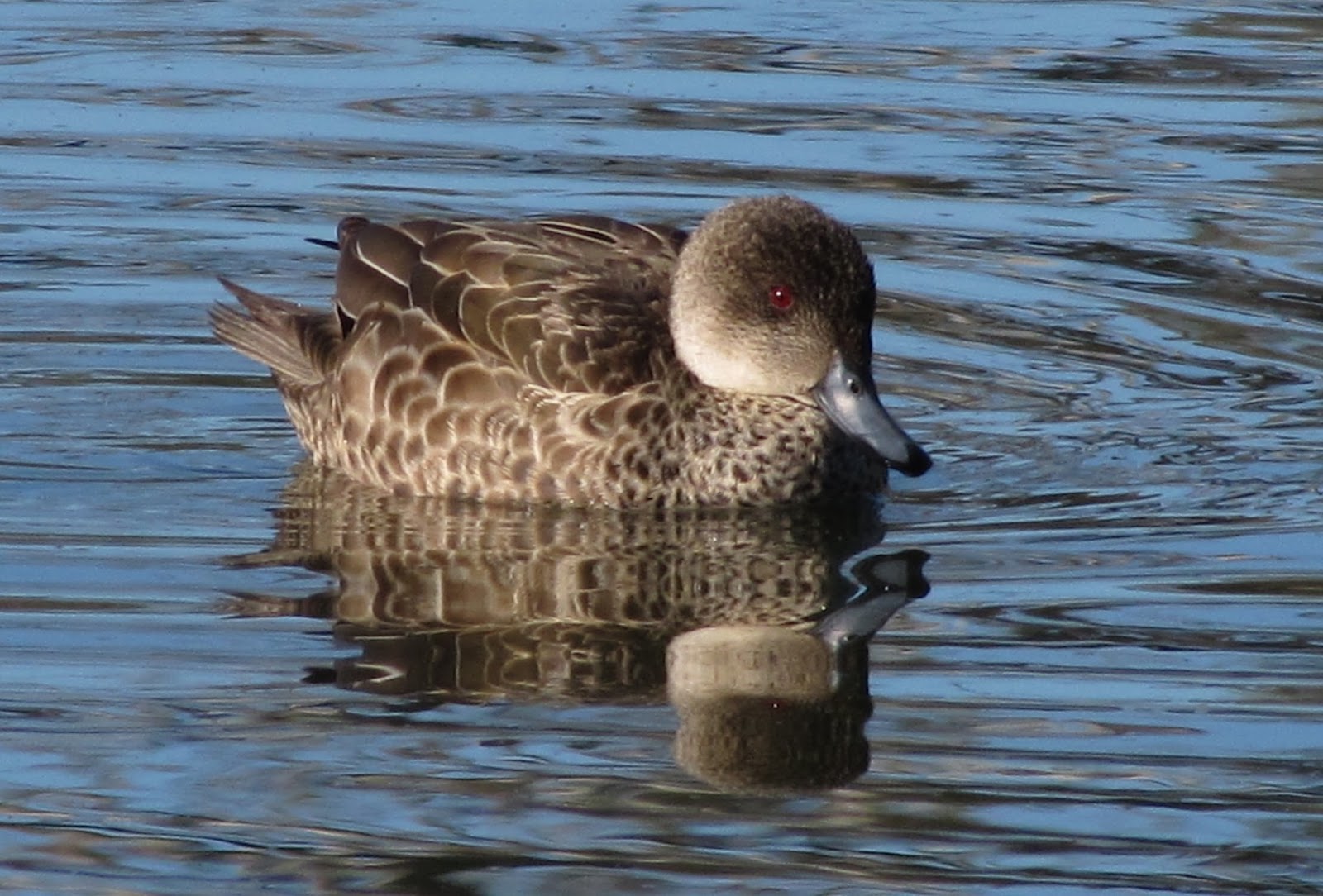
Grey Teal, Laratinga Wetlands
 | |
| Grey Teal |
Grey Teal are one of the more numerous ducks found in Australia. They can sometimes number in the thousands on a lake, swamp or reservoir. They are often seen in close association with Pacific Black Ducks, another very common Australian duck.
The photos I am sharing today were taken recently in the Laratinga Wetlands near Mt Barker in the Mt Lofty Ranges of South Australia. These wetlands are about a half hour drive from my home in Murray Bridge, and also a half hour drive from our capital city Adelaide.
The walking tracks around the wetlands are popular with both locals and visitors. Many people visit daily for picnics, walking, running, cycling, photography, birding or just plain relaxing.
For more articles about Australian birds, as well as many more photos of birds, check out my other site, Trevor's Birding.
 |
| Grey Teal |
Thursday, August 27, 2015
Have you read these?
 | ||
| Sulphur-crested Cockatoo |
As a reader of this site about Australian birds you may not be aware of other sites that I write for. So indulge me a little while I do a little cross-promotion.
This site - Trevor's Twitching - is only about the wild Australian birds I have seen and photographed in the natural environment. In a week's time it celebrates its 10th birthday. There was a time a few years ago when I was completing my Master of Arts Creative Writing degree when I didn't add much here, but now I have more time to devote to posting new photos and articles.
I also have another birding site called Trevor's Birding (click here). That site is also about birds found and photographed here in Australia but it is much more. I include many more photos than on that site, articles about birding and equipment reviews, links to other birding sites, reviews of books and DVDs about birds and articles and photos of non-Australian birds. On a global scale it is a very popular site.
Trevor's Travels is the second site I write for and maintain. On this site I write about my travels in various countries as well as here in Australia. The other countries include Thailand, Nepal, Ethiopia, Morocco and Spain. Photos of these places feature prominently.
My third site is quite different. Trevor's Writing is about my writing life. Included on this site is some of my fiction, poetry, short stories, writing hints and ideas as well as reviews of books I have read. On this site I hope to announce details of some eBooks which I plan to publish in the very near future.
Yet another site I maintain and also do some writing for is our church site, the Murray Bridge Church of Christ in South Australia. I probably only write about 25% of the material on this site.
Don't forget that you can also follow me on Twitter (@TrevorHampel) and on Facebook as well.
Links:
- Trevor's Birding
- Trevor's Travels
- Trevor's Writing
- Murray Bridge Church of Christ, South Australia
Thursday, July 30, 2015
Pacific Black Duck
 | |||
| Pacific Black Duck, near Mannum, South Australia |
Earlier this year my wife and I went for a drive from our home in Murray Bridge to Mannum in South Australia. Both of these towns are situated on the Murray River, Australia's largest river. After a delicious picnic lunch - bought from a local bakery - we drove along the river towards the town of Bow Hill.
Along the way we stopped at a locality called Younghusband, a small community of houses - many of them holiday homes - and a small general store and caravan park. While having afternoon tea in a picnic area next to the river I photographed the Pacific Black Duck (see above) and the Australian Pelican soaring above the river (see below).
It was lovely day and we saw some wonderful birds.
For more photos and information about Australian birds visit my other site called Trevor's Birding here. Or you might want to read about my travels in Australia and overseas on Trevor's Travels here.
 |
| Australian Pelican soaring over the Murray River in South Australia |
Thursday, July 23, 2015
Whistling Kite over the Murray River
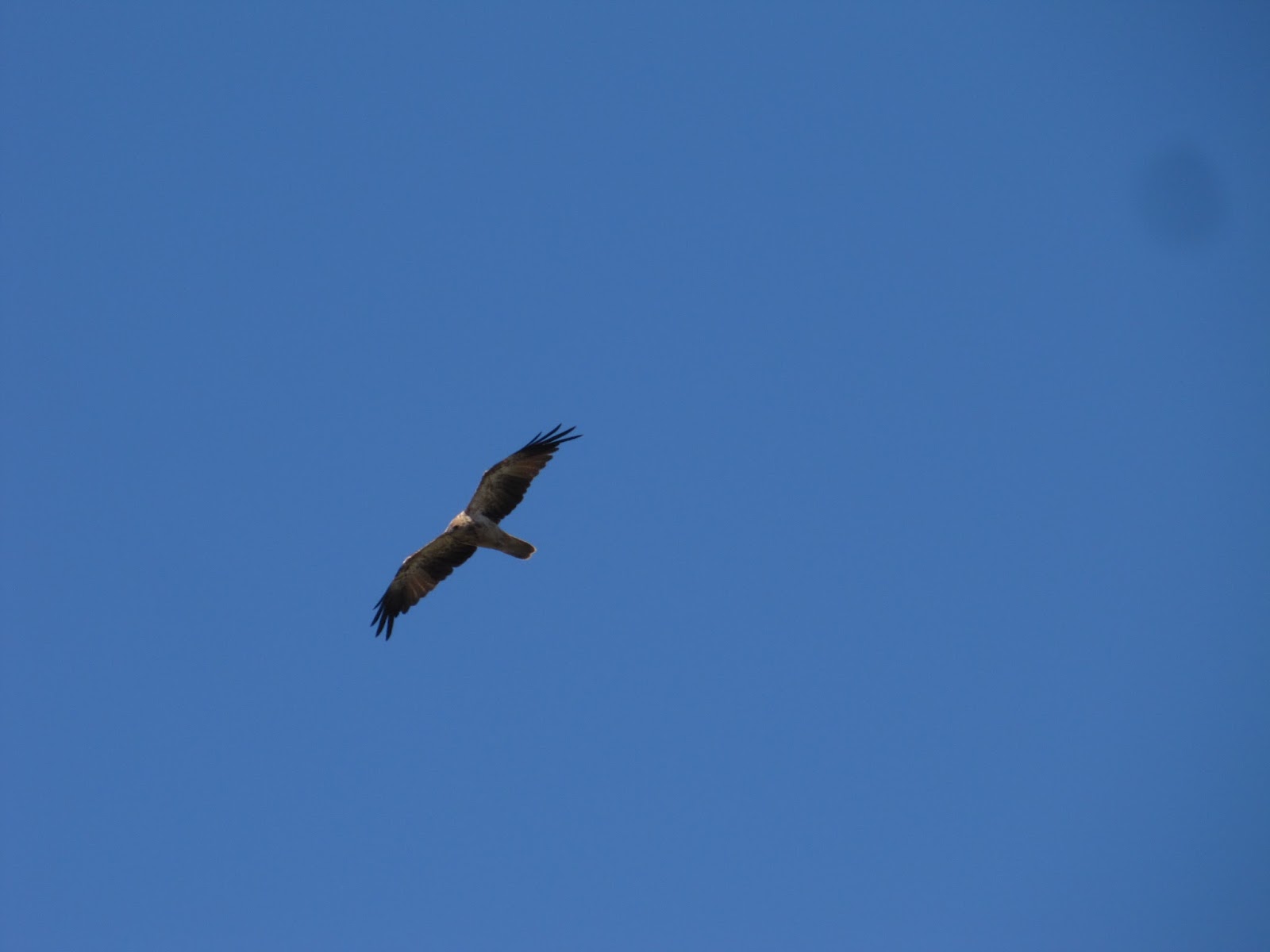 | ||
| Whistling Kite over the Murray River, South Australia |
A few months ago my wife and I went for a day trip to Mannum which is about a half hour's drive from our home in Murray Bridge. We didn't go directly there but took several detours along the way. On arriving in Mannum we went to the local bakery and bought a few delicious items for lunch. We enjoyed our picnic lunch overlooking the nearby bird sanctuary next to the caravan park.
After looking through a few of the local shops we headed off from Mannum, crossing the Murray River on one of the two ferries which take vehicles across this part of Australia's largest river. We then followed the river along to Bow Hill, a farming community upstream. Along the way we stopped in a picnic area for afternoon tea: a cup of tea and the rest of the goodies from the bakery.
While we were sitting at the picnic table I made a list of the birds observed in the vicinity. I also photographed the Whistling Kite soaring above the river and tree-tops - see the photo above. Just as we were about to leave the PS Proud Mary came steaming past. We must go on one of their cruises one day.
You can read more about Australian birds on my site Trevor's Birding here, and also about my travels here in Australia and overseas on Trevor's Travels here.
 |
| PS Proud Mary on the Murray River in South Australia |
Wednesday, January 21, 2015
White-browed Babblers
 | ||
| White-browed babbler |
They are busy birds, scratching around in dirt, leaf litter and under the bark of trees as they look for beetles, caterpillars, spiders and other bird delicacies.
Their soft meowing call sometimes sounds like we are being invaded by cats.
As they move around the garden and into the adjoining scrub they tend to hop rather than fly.
You can read more about Australian birds on my other site called Trevor's Birding, together with many more photos of our wonderful birds.
Tuesday, July 16, 2013
Australian Red-rumped Parrot
 |
| Red-rumped parrot |
This photo was taken at the Riverglades Wetlands area near Murray Bridge, South Australia.
You can see more photos and read more about Australian birds on Trevor's Birding here.
Saturday, October 13, 2012
Crested Tern, Sturt Reserve

This Crested Tern was resting on a small jetty at Sturt Reserve on the River Murray in my home town of Murray Bridge in South Australia recently.
Crested Terns are common, sometimes in large numbers, in suitable habitat throughout Australia.
For more photos and information about Australian Birds, visit my other birding site, Trevor's Birding here.
Subscribe to:
Posts (Atom)