Showing posts with label Honeyeaters. Show all posts

Friday, May 19, 2017

Noisy Miners

Noisy Miner - an Australian native honeyeater


My wife and I recently spent a few weeks in Sydney. We travel the 1300 kilometres to Sydney several times a year. These visits usually now often coincide with the school holidays. We go to look after our two grandchildren. It is a trip we always enjoy undertaking, not just because of spending time with the children, but also so we can explore the country along the way, and on the return trip.

While in Sydney we often go out to nearby parks or national parks. It is fun exploring such places with the children. They are so eager to observe and learn about the natural environment. Naturally, they take an interest in plants and flowers which are my wife's main interest. I am also pleased that they are quite knowledgeable about our native birds. I wonder where that comes from?

On one of these visits to the natural environment near to their home, I took the above photo of a Noisy Miner. This is one of our many species of honeyeaters here in Australia. Their name is truly apt, especially if there is a bird of prey nearby. They certainly know how to create a noisy response to any danger.

Some Australian bird lovers do not really like this species. In some places, they are very common and bossy. Their belligerent attitude often forces smaller species out of gardens and parks. Species such as fairywrens, finches, pardalotes and thornbills move on to other areas, much to some people's annoyance.

For more photos and stories about Australian birds, please visit my other site Trevor's Birding.

Saturday, January 07, 2017

Ku Ring Gai Wildflowers Gardens in Sydney


Laughing Kookaburra

My wife and I travel to Sydney several times a year to help look after our grandchildren, ages 8 and 5. Although they are very energetic and tire us out, we love being with them and getting to know them. On a visit last year, we took time out to go on a family picnic. One of our favourite places to visit would have to be the Ku Ring Gai Wildflower Gardens in the suburb of St Ives.

These gardens consist of two main parts: a planted garden of Australian native plants, with the rest being natural scrubland. The scrubland section is the largest part and gives the visitor a good impression of what this part of Sydney was like in its natural state, before settlement by Europeans.

The whole area is covered by walking trails which are easy to negotiate. In springtime, many of the plants are flowering. Even at other times of the year, you can find something flowering. Where there are native flowers the observant visitor will also find plenty of native birds, many of them feeding on the nectar of the flowers.

I have seen a good range of honeyeaters in these gardens, including Eastern Spinebill, Scarlet Honeyeater, Crescent Honeyeater, Yellow-faced Honeyeater, Lewin's Honeyeater and both Red and Little Wattlebirds. One can also see a range of parrots, including Galahs, several species of cockatoos and lorikeets, finches, doves and pigeons, pardalotes, thornbills, robins, swallows, fantails and scrubwrens. Australian Brush Turkeys are often seen in the picnic areas, but seeing a Superb Lyrebird is a little bit harder, but they have been seen in these gardens from time to time.

You can read more about Australian birds, and see more photos of them on my site called Trevor's Birding.


Wednesday, February 24, 2016

Getting crowded at our bird bath

White-browed Woodswallow (L), Magpie Lark (C) and Brown-headed Honeyeater (R)

Over recent posts on this site I have mentioned how hot it has been here in South Australia this summer. Some of our heat waves have broken records in many places. We have also had several major bush fires in our state.

On hot days I am especially careful to maintain fresh, clean water in our various bird baths in our garden. I know that the birds appreciate having plenty of fresh water to drink, and to bathe in during the warm weather. They also seem to like the water supplied no matter what the temperature.

On one occasion several weeks ago I took the photo above showing three different species at the bird bath at the one time. This happens more often than one might think. On a hot day I have counted up to a dozen or more species using the water in a very short space of time, such as a ten minute period. On this occasion we had (from the left) a White-browed Woodswallow, an Australian Magpie-lark, and a Brown-headed Honeyeater.

You can read more about Australian birds on my other site Trevor's Birding

Thursday, December 31, 2015

Birds in the heat

White-browed Woodswallow (L) and Australian Magpie-lark (R)


In the week before Christmas we had a sudden heat wave here in South Australia. Over four consecutive days much of the state had temperatures over 40C (104F). On the worst day Port Augusta's temperature reached a sizzling 47.2C (117F).

That's hot.

Really hot.

 This heat wave was unprecedented because we usually get consecutive days of severe heat in January and February, rarely in December.

On the last day of this heat wave I sat at our sun room table taking note - and photos - of the constant parade of birds coming to our bird bath. Most of them looked very stressed by the fiery north wind. Many came for a drink; a few for a bath. Most lingered for many minutes enabling a few good photos.

Australians in particular should be aware of the plight of birds on days of extreme heat. Put out a few bowls of water in shady spots so the birds can have a drink. Place the bowls near to a bush or tree so that they have a safe route of escape from predators. 

Spiny-cheeked Honeyeater feeling the heat

Thursday, November 05, 2015

New Holland Honeyeater, Browns Road

Eucalyptus flowers
A few weeks ago I visited a locality known as Brown's Road. This is about a twenty minute drive from my home in Murray Bridge, South Australia.  The area is a mixture of mallee (eucalyptus) woodland and native pine, with an understory of smaller shrubs and plants like acacias (wattles). A good part of this reserve has been planted, not exclusively with local native plants but with some introduced plant species from other parts of Australia. In recent years this has become a popular birding spot with South Australian birders.

On this occasion the birding was very slow and I only saw and heard a handful of birds. Granted, I did not walk too far into the forest because of my aching back. Although I had my camera at the ready, the only bird I managed a photo of was the New Holland Honeyeater shown below.

Other birds seen or heard include:
  • White-browed Babblers - seen skulking in the bushes
  • Galahs - flying overhead
  • White-winged Chough - heard in the distance, and seen on roadside as we drove off
  • Red Wattlebird - they wouldn't perch long enough for a photo
  • Peaceful Dove - heard nearby
  • Grey Fantail - it wouldn't sit still for a photo
  • Yellow Thornbill - flitting around in a bush but wouldn't come out to pose
  • Silvereye - a small flock flew overhead calling
  • Grey Shrike-thrush - heard calling in the distance
  • Adelaide Rosella - about four flew quickly through the trees
  • Crested Pigeon - several seen perched on the farm fence opposite the reserve
  • Weebills - feeding high in the tree canopies
You can see photos of some of these birds by using the "Search" facility in the top right hand corner of each page on this site.

You can also seen photos of all these species and many more on my other site Trevor's Birding.  That site also has many more articles about Australian birds.

New Holland Honeyeater
Browns Road near Murray Bridge, South Australia

Acacia (wattle) in flower at Browns Road, South Australia

Sunday, June 17, 2012

Grey Butcherbirds of Australia

Grey Butcherbird


One of the birds we often have in our garden here in South Australia is the Grey Butcherbird. Many of the smaller birds, like the honeyeaters and thornbills, set up quite a racket when the butcherbird flies in. Although they eat plenty of insects and small reptiles, Butcherbirds are also quite happy to take the young of many species of birds.

I like having them around because of their beautiful, far-reaching call which is strong and melodious.

You can learn more about Australian birds on my other site, Trevor's Birding.


Tuesday, May 22, 2012

New Holland Honeyeaters


New Holland Honeyeaters are very common in our garden. They outnumber most of the other bird species, with the possible exception of House Sparrows. They love coming to our bird baths for a drink - or a splash in the water. They also enjoy the many native Australian bushes and trees in our garden. In the spring and summer they nest in various places around the garden.

For more articles about Australian birds, go to my other site Trevor's Birding.

Monday, May 10, 2010

Singing Honeyeater


There are many different kinds of honeyeaters in Australia. These birds, as their name suggests, are largely nectivorous. Many also eats fruits, berries and insects. We regularly have seven different species of honeyeaters in our garden, most of them resident breeding species.

The Singing Honeyeater is one of these species, present in small numbers, perhaps 4 - 6 at any one time. During our long hot and dry summers they enjoy coming to our bird baths for a drink. They also enjoy feeding on the nectar of the flowers of the many native Australian plants we have in our garden.

To find out more about Australian birds click here.

Wednesday, September 07, 2005

Hi there honey - encounters with honeyeaters

We are not short of honeyeaters in Murray Bridge. They are common everywhere in this district and are probably the most common bird in most people's gardens. Other species may outnumber them along the river or in the farming areas. For example, Straw-Necked Ibis numbers along the dairying flats are very numerous. I have seen flocks of over 400 on many occasions. Flocks of Galahs of that size are also evident, especially where wheat is cultivated. Along the parks and trees lining the River Murray large flocks of Little Corella can also be seen on occasions.
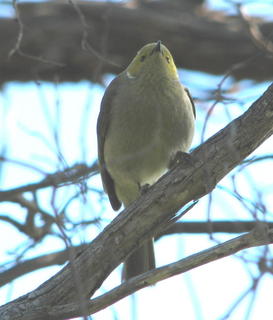
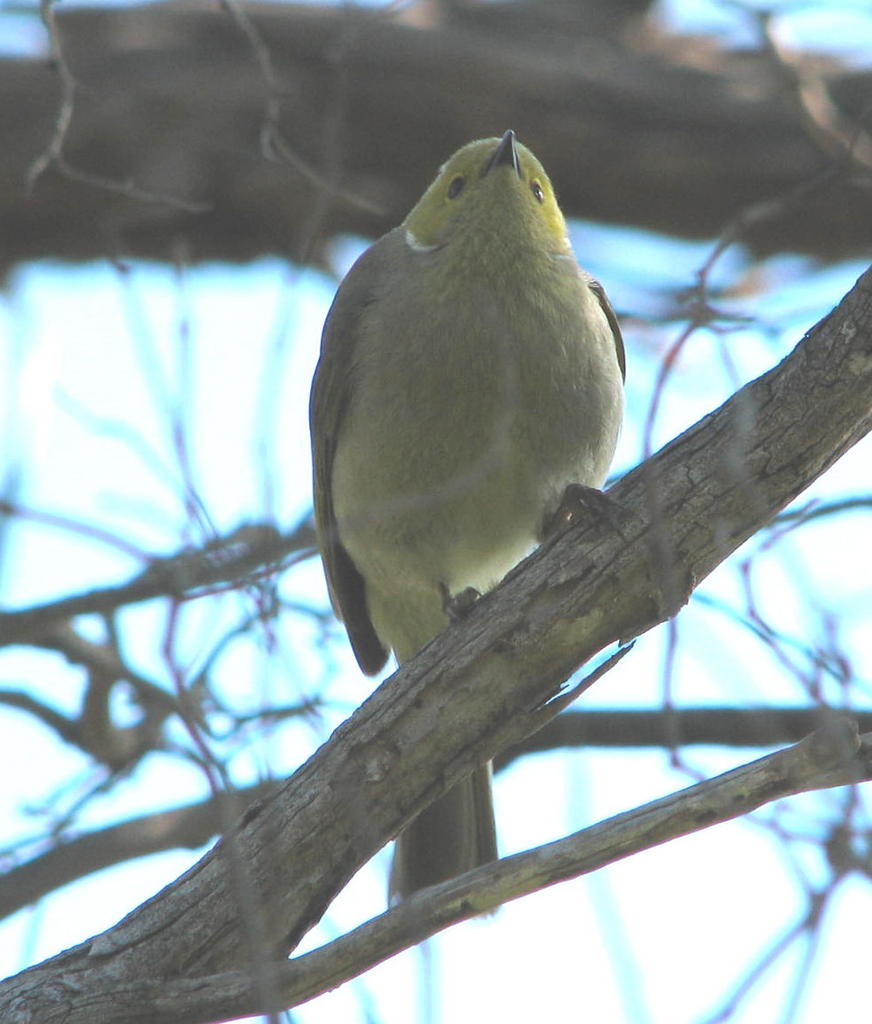
White-plumed honeyeater
In the gardens, however, the honeyeater species tend to dominate. We do have some Noisy Miners in the area but they are not (yet) the dominant species they seem to be in other parts of Australia. In the Murray Bridge district New Holland Honeyeaters probably outnumber all other species of honeyeater. Red Wattlebirds are also very common as are White-plumed Honeyeaters.
Last Monday we went to visit my wife's mother. She lives in a retirement village, Murraylands. Part of the complex opposite her unit is a plantation of native Australian plants, established 20 years ago and maintained by the local members of the Australian Plant Society. The local group is in recess due to lack of members, Corinne (my wife) is the immediate past-president and I am also a past-president.

While Corinne was collecting cuttings for propagation I was taking photographs of various flowers for her. (I have included several photos at the end of this posting.) There were many birds in the locality, including a number of White-plumed Honeyeaters. Two of them came close to investigate what I was doing, so I took several photographs. I was basically shooting into the sun so the photos are not candidates for "Best of Show" in an exhibition. They turned out quite dark so I have enhanced them to show them here. I only include them here because of the unusual stance of the birds.
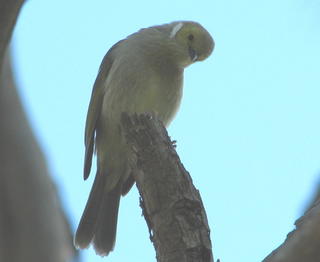
White-plumed honeyeater
The first photo (above) shows one bird looking straight down at me. The eyes are what caught my attention. It's a rather bizarre view of a bird. The second photo shows the other bird's response to the focussing beep on my camera. It obviously heard the soft beep as I focussed. Pity about the lack of colour.

The native plant garden at Murraylands Homes is about an acre in size. It includes a wide range of Australian plants, including eucalypts, wattles, grevilleas, correas, eremophilas, callistemons and many others. Below I have included a selection of the shots I took.
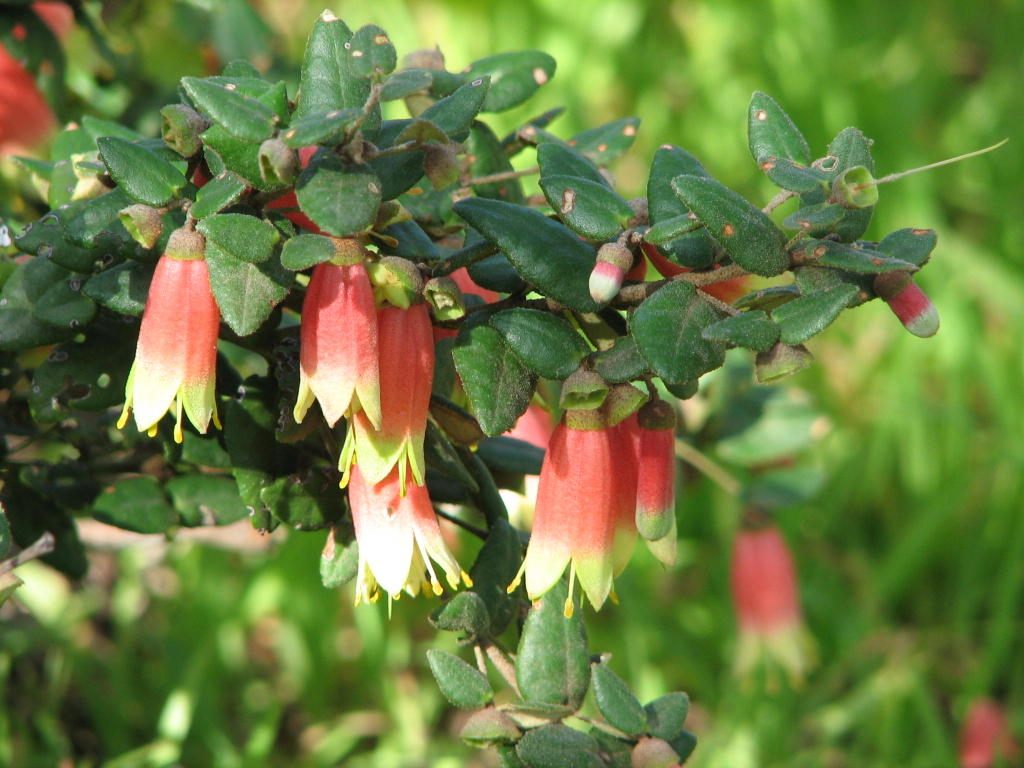
Correa reflexa "Sellick's Beach"


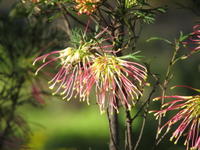
Grevillea "Winpara sunrise"

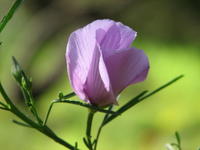
Alyogyne huegelli (Native hibiscus)


Monday, September 05, 2005

New Holland Honeyeaters

New Holland Honeyeaters are a common Australian bird, especially in parks and gardens. Good views of them can be easily had as they flit to and fro from bush to bush. Sometimes they even sit still enough for good views of their beautiful markings. On rare occasions they even sit long enough to capture a photograph!

This stunning photograph was taken a few days ago while looking over our neighbour's fence. The bird posed long enough for me to take several shots. The green object it is perched on is the handle of a small hand operated plough. Our neighbour has several old farm implements in his front garden.

New Holland Honeyeater
Over the years I have been interested in the occurrence of New Holland Honeyeaters in our garden. They are probably the most numerous and widespread species of honeyeater in the Murray Bridge region. In the first 15 years of us living here they were only occasional visitors to our garden and patch of mallee scrub. I have kept monthly records of all birds seen on our property since January 1985. My database of bird observations (BirdInfo) shows a sudden increase of observations in late 1998. From that time to the present New Holland Honeyeaters have been the predominant honeyeater species here.

Other species of honeyeaters recorded here include:

New Holland Honeyeater
Red Wattlebird: resident, breeding species.
White-plumed Honeyeater (resident, breeding)
Spiny-cheeked Honeyeater (resident, breeding)
Striped Honeyeater (occasional visitor, one breeding record)
White-eared Honeyeater (occasional visitor)
Yellow-plumed Honeyeater (occasional visitor)
Singing Honeyeate
r (resident, breeding)
Brown-Headed Honeyeater
(resident, breeding).

One possible explanation of this change is the maturing of many of the native Australian plants we have planted over the years. Our property is now far more bird welcoming than, say 15 years ago.